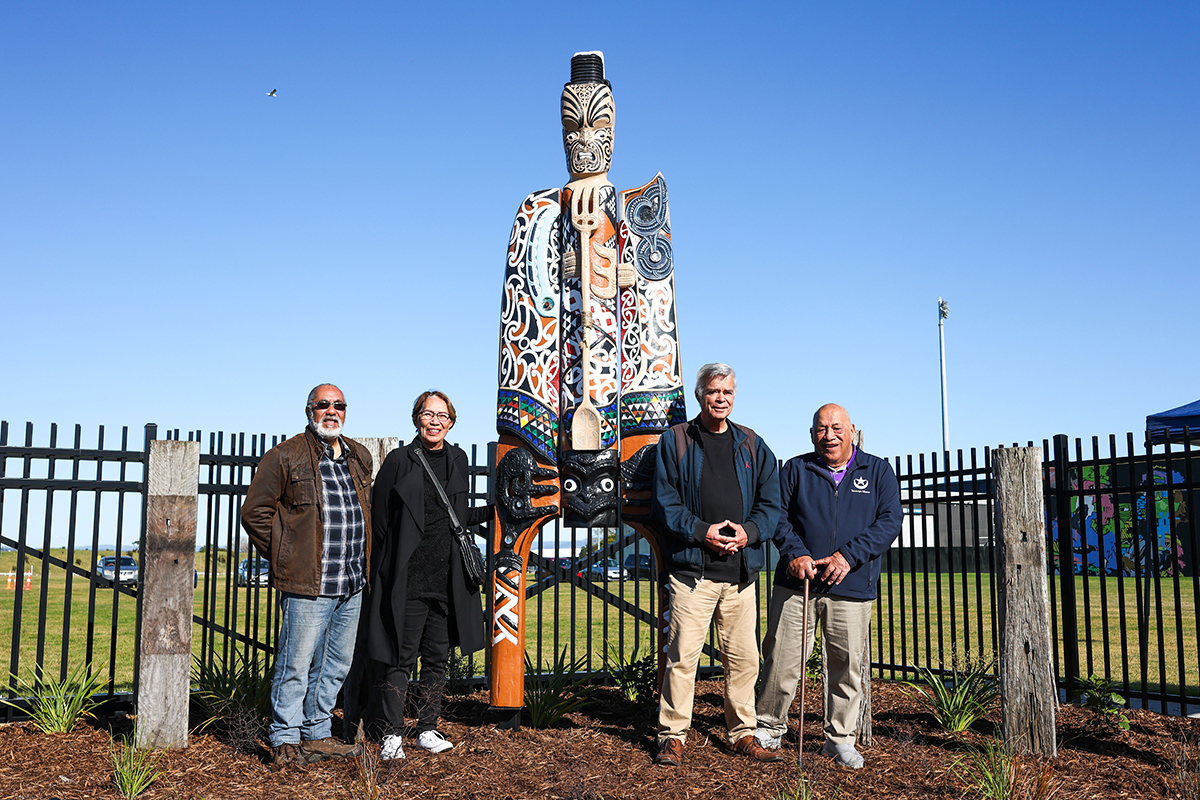
A significant but seldom seen artwork depicting a prominent Ngā Pōtiki chief now stands proudly at the entrance of Mercury Baypark.
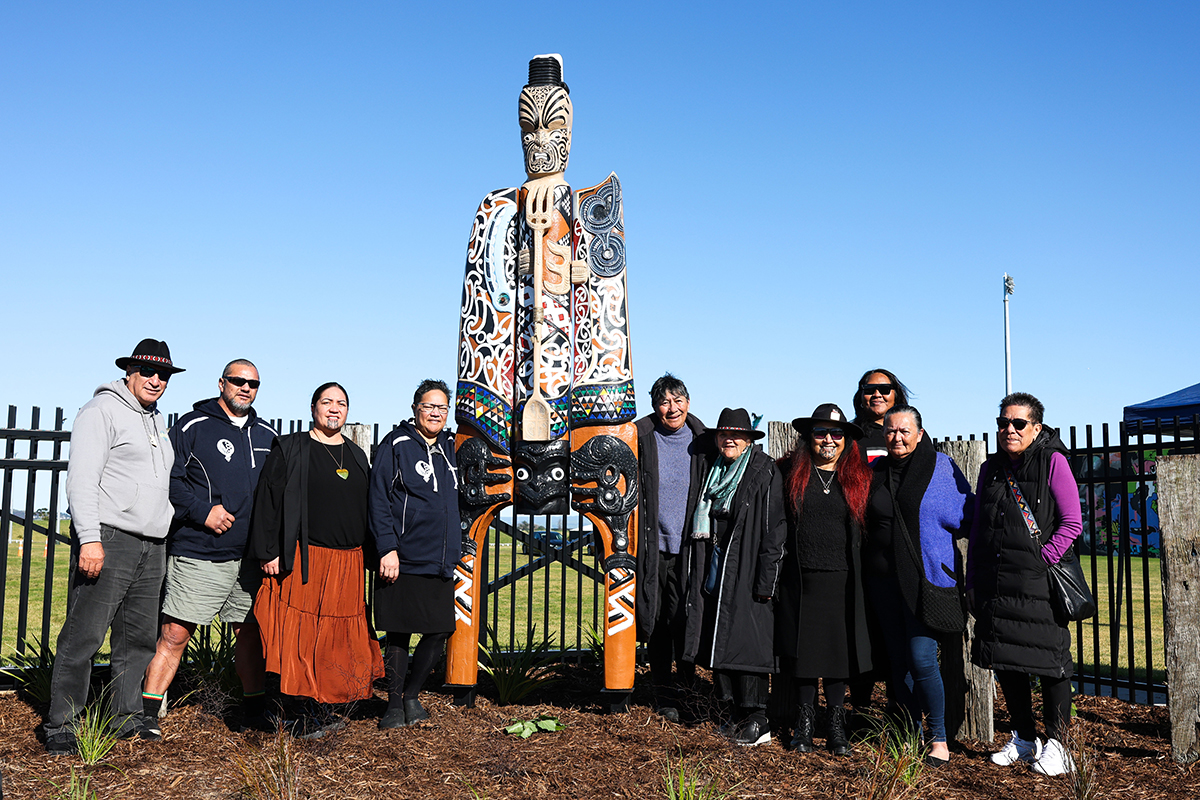
The 4-metre Pouwhenua ō Tamapahore has been on the Baypark site for years, located outside the Arena, and was recently restored and relocated to a more prominent position at the refreshed entrance.
This carving by master carver Dean Flavell pays tribute to the deeds and achievements of the rangatira Tamapahore. It depicts Tamapahore, a prominent chief of the local Ngā Pōtiki tribe, who lived on the shores of Te Tāhuna o Rangataua (Rangataua Bay) and is credited with founding the mana whenua that bears his name, Ngā Pōtiki ā Tamapahore.
In August, the restored pou was unveiled and blessed at a special ceremony with Ngā Pōtiki kaumātua, kuia and whānau in attendance.
This is the story of Pouwhenua ō Tamapahore.
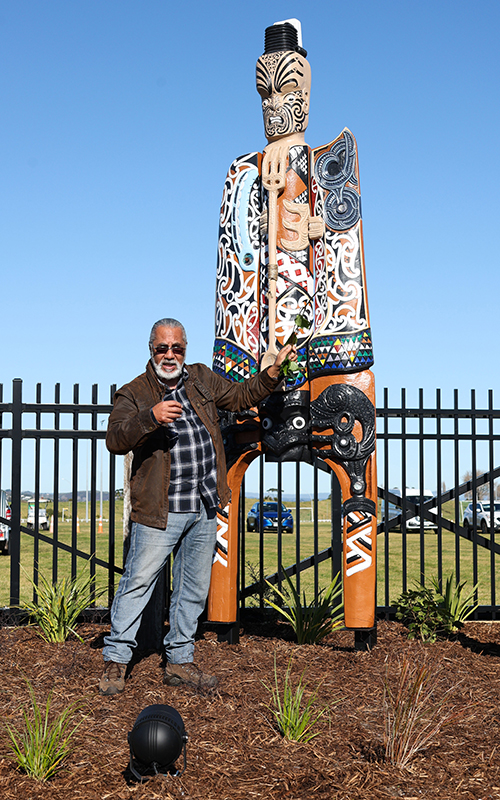 “Ko ia tapahi he kōrero pakiwaitara,” Dean Flavell says.
“Every cut tells a story.”
The tohunga whakairo (master carver) has carved marae and countless artworks throughout the country.
His most recent carved meeting house is in the Eastern Bay of Plenty at Kutarere Marae, Ohiwa Harbour. This fully carved whare tupuna, named Tamaterangi, tells many stories of early ancestors, such as the ancient tribe, Te Hapuoneone Toitehuatahi, and descendants of the Mataatua waka migration.
Within this house stands Tamapahore, a poupou (ancestral wall carving) that acknowledges the early origins of Ngāi Te Rangi and Ngā Pōtiki, prior to migration to Tauranga Moana.
But one of Flavell’s most significant works is a pou that pays tribute to the deeds and achievements of the Ngā Pōtiki rangatira Tamapahore. The prominent chief lived on the shores of Te Tāhuna o Rangataua (Rangataua Bay) and is credited with founding the mana whenua that bears his name, Ngā Pōtiki ā Tamapahore.
The carving has been installed at the entrance to Mercury Baypark, and will stand within line of sight of the landmarks that signify home for Tamapahore’s descendants.
Stories carved in wood
Pouwhenua ō Tamapahore was crafted from tōtara salvaged from the original wharf in Tauranga, which was built in 1871 and from which Wharf Street was named. This early wharf served as a central point for shipping and trade in the city's early years.
Flavell explains that the salvaged timber beams were removed during the upgrade of The Strand. The upgrade included development of tidal steps, a pier, and a pontoon, creating a space for recreation and relaxation.
He says he saw an opportunity to utilise the wood.
“To be able to repurpose these tōtara piles towards a noteworthy project, acknowledging dual historical references to our common histories, seemed appropriate.”
At the base of the timber piles were shipworm markings. These marks were valued in the final work, echoing the sentiment of the whakatauākī “He iti mokoroa e hinga pūriri”, which translates to “The small grub can fell a pūriri tree”.
Flavell says, “It reminds people that small things can have a big impact”.
He says for carvers, every mark, notch, or cut can convey a suggestion that another layer or meaning exists.
Flavell is the Tauranga Museum Te Pou Ārahi. In the museum collection are carvings from an original meeting house, called Tamapahore, which once stood at Karikari Point on the banks of Te Tāhuna o Rangataua. Flavell is excited to share the region’s taonga (historical artefacts) through the new Tauranga Museum, due to open in 2028.
A warm welcome
The 4-metre Pouwhenua ō Tamapahore stands proudly at the entrance of Mercury Baypark, welcoming visitors to the traditional lands of Ngā Pōtiki.
It represents the ancestral connection that embodies the rich history and cultural heritage of Ngā Pōtiki, reflecting their deep connection to the land and ancestors, and showcases the skill and artistry of Māori carvers.
It features intricate patterns, shapes, and symbols that tell stories and convey meaning which serve as a visible marker of Ngā Pōtiki, acknowledging their role as kaitiaki (guardians).
The carving warmly invites visitors to explore Mercury Baypark, learn about the local culture, and experience the natural beauty of the area.
Pou design
The carving is made from three pieces of wood, positioned side-by-side. The cloak draped around Tamapahore’s shoulders incorporates a whale – a reference to the legend of a stranded family of whales whose forms can be seen in the shape of the whenua (land) at Mangatawa.
On the right is a manaia, to guard the descendants of Tamapahore.
An ancient taniko pattern, the niho taniwha, decorates the cloak, underscoring Tamapahore’s high standing in society.
In front is a kāheru (gardening spade) to recognise the ways cultivation and settlement fashion the land and unite people.
Along the bottom of the artwork is a tribute to Ngā Pōtiki and the other hapū that live around the Rangataua arm of the harbour and refer to themselves as the crabs of Rangataua. That connection to the harbour is expressed in the following tribal proverb:
“Ngaro noa ke te tangata, waiho ma ngā pāpaka o Rangataua e mihi.”
“The people may disappear but the crabs of Rangataua will always be there.”
A family of artworks
In the refreshed entrance to Mercury Baypark, Tamapahore stands near a group of contemporary artworks by Flavell's whanaunga Linda Munn (Ngāpuhi, Ngāi Te Rangi, Ngā Pōtiki, Te Āti Awa, Ngāi Tahu). Together the pieces visibly anchor the area, once known as Te Maunga junction, as part of the rohe of Ngā Pōtiki.
Munn, perhaps best-known as one of the designers of the tino rangatiratanga flag (mandated as the national Māori flag), created one of three pou that stand on the large SH29A roundabout near Mercury Baypark. Her artwork faces Mangatawa and is named Parewaitai.
This is the name of two important Ngā Pōtiki tūpuna. The first Parewaitai was the daughter of Tamapahore; the second Parewaitai was a Ngā Pōtiki tupuna who was one of four kuia taken captive in 1836 and repatriated to Tauranga Moana in the 1860s.
Munn also created three artworks for the walkway leading down from the Te Maunga interchange overpass to Truman Lane. This area is a significant boundary point between different hapū.
At the top of the walkway is a taurapa (carved waka stempost) called Te Kitenga o Te Aohuakirangi. It references the seat of responsibility a navigator has with respect to their people. Te Aohuakirangi was an authority on whakapapa, mōteatea, and other vital aspects of Ngāpōtikitanga.
Halfway down the Truman Lane pedestrian ramp is a muri paraoa (whale tail) named Te Hangahanga o Taia. It references the special connection Ngā Pōtiki has with the moana. Taia was a mokopuna of Tamapahore and was known for harvesting food from the ocean and sailing open waters.
At the bottom of the walkway is the grounding feature of the three artworks – a kohatu mauri (life force stone) called Te Rauru o Rongomainohorangi. It references Ngā Pōtiki ancestor Rongomainohorangi while rauru symbolises the umbilical cord – the iwi’s connection to this land and water.